Top 10 Composting Worms
Worms have this amazing ability to turn decomposing materials into a powerful organic fertilizer.
Here are ten types of composting worms commonly used for vermicomposting:
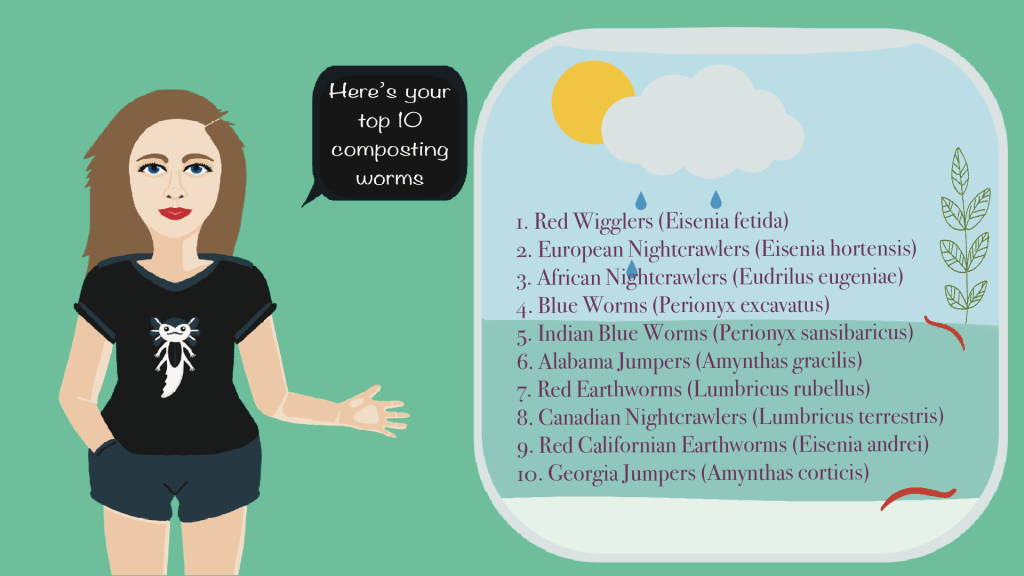
It’s essential to choose the species that best fits your composting setup and environmental conditions. There is between 7000-9000 species of earthworms, but only a handful are good for composting.
1 Red Wigglers (Eisenia fetida)
Perhaps the most widely recognized composting worm, red wigglers are prized for their voracious appetite and rapid reproduction rate. These small, reddish-brown worms thrive in a variety of conditions and can consume their body weight in organic matter daily. Red wigglers are well-suited for household vermicomposting systems and are commonly found in worm bins and compost heaps around the world.
2 European Nightcrawlers (Eisenia hortensis)
Are larger and more robust than red wigglers, making them popular choices for larger-scale vermicomposting operations. These worms are capable of processing significant amounts of organic waste and are particularly well-adapted to cooler temperatures. European nightcrawlers are prized for their resilience and are often used in commercial composting facilities.
3 African Nightcrawlers (Eudrilus eugeniae)
Are well-suited for warm, humid environments. These large, robust worms are voracious eaters and can process large quantities of organic matter quickly. African nightcrawlers are popular choices for composting in subtropical and tropical regions, where they thrive in outdoor compost piles and worm farms.
4 Blue Worms (Perionyx excavatus)
Are particularly well-suited for vermicomposting in tropical climates, where they can help break down organic waste in outdoor bins and compost heaps.
5 Indian Blue Worms (Perionyx sansibaricus)
Are efficient decomposers, processing various organic materials into nutrient-rich castings ideal for soil enrichment. They thrive in warm and humid environments, making them well-suited for composting in tropical climates. Prolific breeders, they reproduce through clitellum mating and can rapidly multiply under optimal conditions. Indian Blue worms are valuable allies in vermicomposting, contributing to sustainable waste management and healthier soils.
6 Alabama Jumpers (Amynthas gracilis)
Are deep-burrowing earthworms, often found in the soil rather than surface layers. They are highly efficient at aerating and improving soil structure due to their extensive burrowing activity. Alabama Jumpers are known for their ability to “jump” when disturbed, retracting quickly into their burrows. They are commonly used in soil improvement projects and vermiculture operations, particularly in agricultural settings.
7 Red Earthworms (Lumbricus rubellus)
Are voracious decomposers, feeding on organic matter such as dead plant material, leaf litter, and decaying organic debris in the soil. They play a vital role in soil health by breaking down organic matter and creating nutrient-rich castings that enrich the soil with essential nutrients. Red earthworms are often used in vermiculture and composting systems to accelerate the decomposition process and produce high-quality compost for gardening and agriculture.
8 Canadian Nightcrawlers (Lumbricus terrestris)
While not traditionally used for vermicomposting, Canadian nightcrawlers are worth mentioning for their significant role in soil health and fertility. These large, earthworms are prized for their burrowing abilities and are commonly found in garden soil and compost piles. While Canadian nightcrawlers may not be as efficient at processing organic waste as their smaller counterparts, they still play a valuable role in aerating and enriching the soil.
9 Red Californian Earthworms (Eisenia andrei)
Are highly efficient decomposers, thriving in organic-rich environments such as compost piles, worm bins, and garden soil. They consume a wide variety of organic materials, including kitchen scraps, yard waste, and paper products, converting them into nutrient-rich castings that benefit soil health. Like other composting worms, Red Californian earthworms play a vital role in vermicomposting, helping to break down organic matter and create valuable compost for gardening and agriculture.
10 Georgia Jumpers (Amynthas corticis)
are a type of earthworm known for their large size, active behavior, and ability to aerate soil effectively. They are often used in vermiculture and organic gardening due to their efficiency in composting and improving soil structure.
Visit us at Michigansgrowhouse.com for more information about composting.